
Key Takeaways
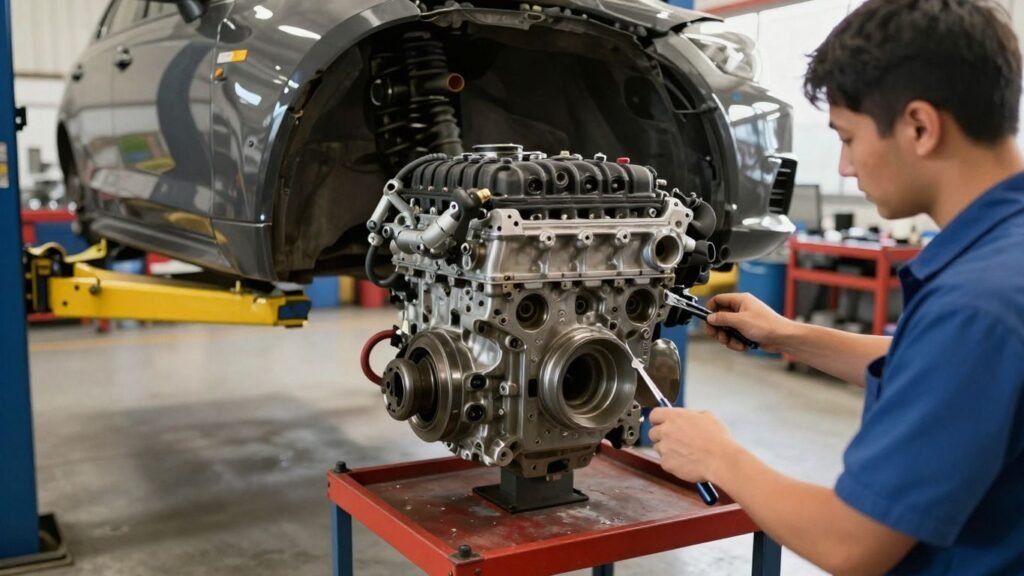
Replacing an engine is a major decision, but a careful process can make it far less uncertain.
- Diagnose the underlying failure before committing to replacement.
- Match the engine code, specifications, and drivetrain precisely.
- Compare used, reconditioned, and new options on total value.
- Get written compatibility, warranty, freight, and installation details.
- Check Australian registration, emissions, and roadworthiness obligations.
Confirm whether an engine replacement is the right solution
An engine replacement can restore a useful car, but it is not automatically the best answer. Start with a proper diagnosis and compare the likely cost of repair, rebuilding, and replacement. The right choice depends on the failure itself, the condition of the rest of the vehicle, and how long you expect to keep it. If you are asking How to find the right engine replacement for my car in Australia, begin by deciding whether replacement is justified at all.
Compare repair, rebuild, and replacement costs
A repair may be sensible when the problem is limited to a gasket, sensor, cooling component, or bolt-on assembly. A rebuild can work when the engine block and major internal parts are serviceable, although machining and parts costs can rise quickly. A replacement engine may offer a clearer budget when internal damage is extensive, but compare like with like: include labour, ancillary parts, fluids, freight, and warranty conditions.
Ask each workshop to explain what its quote assumes. One estimate may cover only the long motor, while another includes accessories, seals, testing, and installation. A lower purchase price is not necessarily a lower finished cost.
Identify signs of catastrophic engine failure
Knocking, metal in the oil, a seized crankshaft, a cracked block, severe overheating, or very low compression can point to damage beyond an economical repair. Even then, symptoms alone are not enough to authorise a replacement. A mechanic should inspect the vehicle and identify why the failure occurred, because a blocked cooling system or lubrication fault could damage the next engine too.
A useful diagnosis should separate confirmed damage from assumptions. Compression results, oil-pressure readings, scan data, and a physical inspection give you something solid to compare with supplier recommendations.
Factor in your car’s age, mileage, and condition
Look beyond the engine bay. Rust, worn suspension, transmission problems, electrical faults, accident damage, and a neglected interior can make a replacement poor value. Conversely, a well-maintained car with a sound body, recent tyres, and a reliable transmission may justify the investment.
Consider the replacement engine’s mileage alongside the vehicle’s mileage. If the car has high kilometres, set aside money for hoses, mounts, belts, seals, and cooling-system work while the engine is accessible.
Check whether the replacement improves long-term value
A replacement can give an older car a second useful chapter, but it rarely turns the vehicle into a new one. Compare the completed cost with the car’s realistic market value and with the cost of buying a different vehicle with a known service history. A replaced engine may be attractive to a future buyer only when the work is documented and the installation was done properly.
For another perspective, a guide to buying a car with a replaced engine can help you think through the questions a future purchaser may ask. The same records that protect resale value also help you judge whether the project is worth starting.
Identify the exact engine your car needs
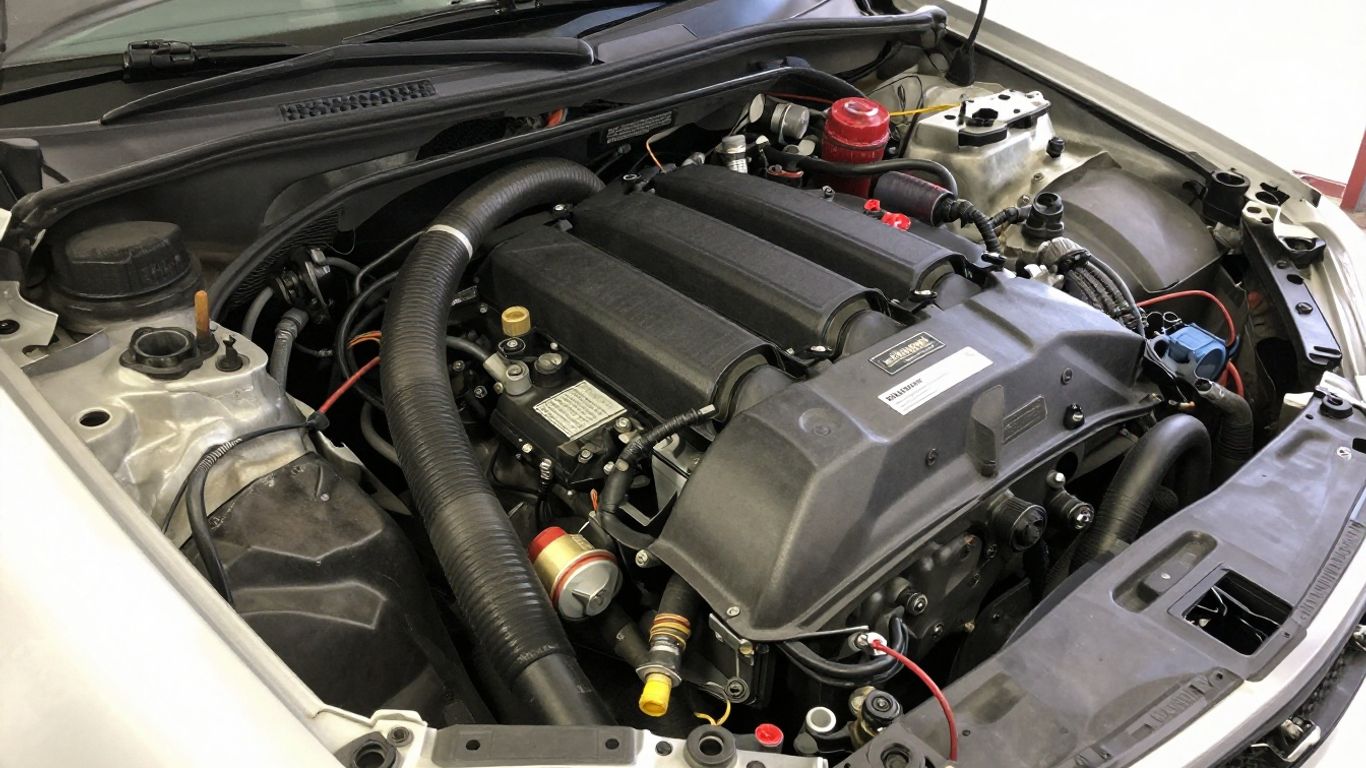
Engine matching is more precise than matching a badge and model name. The same vehicle can use different engines across years, body styles, markets, fuel types, and transmission combinations. Gather the vehicle identification number, engine number, build date, and current engine code before requesting prices.
A supplier should be able to tell you exactly what is included and what must be transferred from your existing engine. Keep photographs of connectors, brackets, sensors, and labels; these small details can prevent a costly mismatch.
Match the make, model, year, and body type
Record the make, model variant, build year, body type, and, where relevant, series or facelift designation. A wagon, sedan, ute, and van may share a model name but use different mounts, wiring, cooling arrangements, or engine-management systems.
Provide the full VIN rather than relying on a registration search alone. The build month can matter when a manufacturer changed engines or electronic systems during a model run.
Confirm the engine code and specifications
The engine code is usually more useful than a broad description such as “2.0-litre petrol”. Confirm displacement, cylinder layout, fuel system, aspiration, powertrain electronics, and whether the listing refers to a complete engine, long motor, or bare block.
Request clear photographs and written identification. If the code on the offered unit does not match your vehicle, ask the supplier to explain the required conversion parts and whether those changes affect warranty or compliance.
Check petrol, diesel, hybrid, and turbo variations
Fuel and induction differences can change injectors, pumps, sensors, exhaust equipment, cooling requirements, and software. Turbocharged versions may also use different manifolds, intercoolers, oil lines, and control systems. Hybrid vehicles require additional care because the combustion engine works within a high-voltage powertrain.
Do not assume that an engine with the same displacement is interchangeable. Confirm the precise variant and the equipment supplied with it before paying a deposit.
Verify transmission and drivetrain compatibility
Check whether the car is manual or automatic, front-wheel drive, rear-wheel drive, or four-wheel drive. Bellhousing patterns, flexplates, flywheels, transfer-case arrangements, engine mounts, and control modules may differ even between closely related vehicles.
Have the workshop confirm which parts will be reused and which will be replaced. A compatible engine can still create delays if the original brackets, wiring, or sensors do not transfer cleanly.
Choose between used, reconditioned, and new engines
The label attached to an engine does not tell you enough about its condition. Ask how the unit was sourced, how its mileage was established, what testing was performed, and what components are included. Price matters, but so do evidence, warranty support, and the cost of correcting problems after installation.
A written comparison makes the choice less emotional. The following questions are especially useful when reviewing listings from Australian suppliers.
Understand the benefits and risks of used engines
A used engine can be the most affordable path and may be suitable when its history, mileage, and condition are documented. The main risk is uncertainty: a salvage unit may have experienced overheating, poor maintenance, or impact damage that is not obvious externally.
All Good Parts describes its pre-owned engines as inspected and tested, and says it offers free shipping Australia-wide. Treat those statements as supplier information to confirm for the exact engine you are considering, including what inspection records and delivery terms apply.
Evaluate reconditioned engines and included components
“Reconditioned” can mean different things, so ask for a written scope of work. Find out whether the engine was stripped, measured, machined, resealed, and tested, and whether the price includes the cylinder head, injectors, turbocharger, manifolds, sensors, or accessories.
A reconditioned unit may offer more predictable service life than an untested used engine, but only if the work is properly documented. Ask which parts are new, which are reused, and what break-in procedure is required.
Consider the price and availability of new engines
A new factory engine may provide the clearest provenance, but availability and price can make it impractical for an older vehicle. Confirm whether “new” means a complete assembly or a replacement long motor that still needs your existing accessories and electronics.
If the unit is imported, ask about lead time, taxes, freight handling, and warranty administration in Australia. A modestly cheaper engine is less appealing if a failed part must be returned overseas.
Compare warranties, mileage, and expected service life
Compare warranty duration, kilometres, exclusions, labour coverage, and claim procedures rather than looking only at the headline period. Check whether the warranty requires professional installation, specified fluids, new filters, or proof of scheduled servicing.
The following compact comparison can help organise the discussion, although the actual terms must come from the supplier and workshop.
| Engine type | Main advantage | Main risk or question | Best suited to |
|---|---|---|---|
| Used | Lower purchase price | Unknown history and wear | A well-documented, budget-conscious repair |
| Reconditioned | Internal work may be addressed | Scope and workmanship vary | A vehicle worth keeping for several years |
| New | Strongest provenance | Highest cost or limited availability | A valuable or newer vehicle |
Use the table as a starting point, not a substitute for a written quote. The exact warranty and included equipment should decide between otherwise similar options.
Find reputable engine suppliers in Australia
A supplier’s website is only the beginning of your checks. Look for a clear business identity, a physical or verifiable operating presence, consistent contact details, and staff who can answer technical questions without guessing. Good suppliers are willing to put identification, condition, price, and warranty terms in writing.
It can also help to compare specialist supply-and-fitting services with independent workshop installation. For example, All Drive Subaroo provides Subaru engine supply and fitting from its Peakhurst facility; if your vehicle is a Subaru, ask what its fitting process covers and whether supply-only is available for your mechanic.
Check supplier experience and business credentials
Ask how long the business has supplied replacement engines and whether it regularly handles your make and model. Verify the legal business name, ABN where applicable, physical address, invoice details, and payment arrangements before transferring money.
Be cautious when a seller will not provide an engine number, written warranty, or return conditions. A professional response should explain the unit’s source and the limits of what can be guaranteed before installation.
Read reviews and verify customer feedback
Reviews can reveal patterns around packaging, delivery, communication, and warranty handling, but read them critically. Look for detailed feedback from customers with similar vehicles and distinguish completed replacement projects from general comments about parts orders.
A used-engine history check may also be useful when buying a car that already had work done. Double Chex discusses checking an engine number against the PPSR register and vehicle logbook, along with physical signs of an engine swap.
Ask about inspection, testing, and quality-control processes
Ask what tests were performed and whether the results can be supplied. Depending on the engine, useful evidence may include compression or leak-down results, oil-pressure checks, cooling-system checks, scan data, photographs, and a recorded run test.
Do not accept “tested” as a complete answer. Ask when the test occurred, what was measured, and whether the warranty applies if a fault appears after installation.
Confirm nationwide delivery and collection options
Freight can be complicated because engines are heavy, contain fluids, and may require a pallet or tail-lift delivery. Confirm the delivery address, access requirements, packaging, transit insurance, estimated timing, and what to do if the crate arrives damaged.
If collection is possible, inspect the unit before loading it and photograph its condition. For delivery, retain the packaging until the workshop has checked the engine and confirmed that no transport damage is present.
Verify compatibility before you buy
Compatibility should be confirmed by two people: the supplier who identifies the unit and the mechanic who will install it. Share the vehicle’s complete details, photos, and existing engine information rather than asking for a generic price. This is where small discrepancies become expensive delays.
A written compatibility confirmation is particularly valuable when a replacement is from a different production year or market. It should state what is included, what is excluded, and whether any programming or conversion work is expected.
Request the engine identification number and documentation
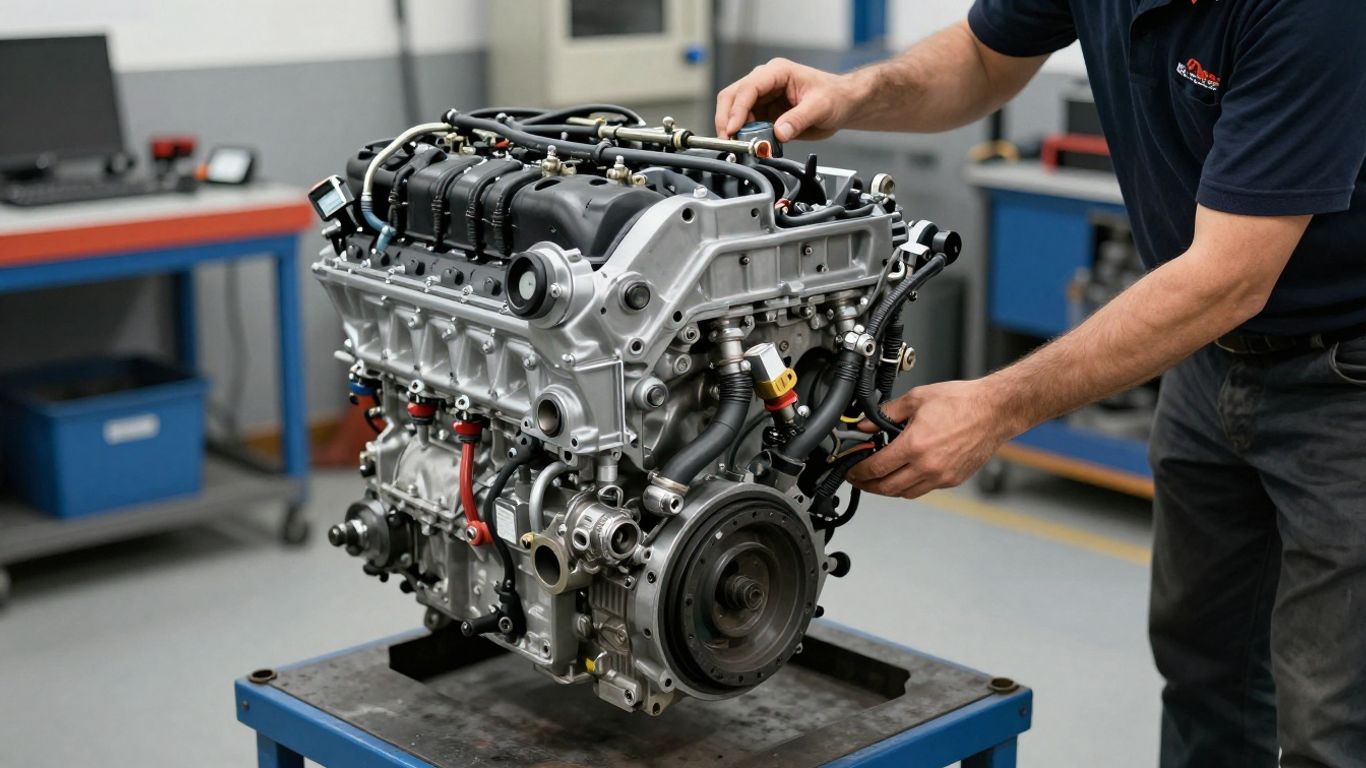
Ask for the engine identification number, donor vehicle details if available, mileage information, and any inspection or testing records. Match the number and code against the invoice before installation, and keep copies of emails, photographs, and payment records.
If the number is unreadable or documentation is incomplete, pause the purchase. The engine may still be usable, but the uncertainty should be resolved before it enters your workshop.
Check electrical, fuel, cooling, and exhaust connections
Compare sensors, plugs, injectors, fuel rails, manifolds, hoses, radiator connections, and exhaust mounting points. Modern engines may require matching engine-control modules, immobiliser programming, or wiring changes even when the physical block fits.
Ask the mechanic to identify every expected adaptation. A short list of required parts is much easier to price before the engine arrives than after the vehicle is dismantled.
Confirm emissions and vehicle compliance requirements
A replacement must not create an emissions or safety problem. Confirm whether the engine’s emissions equipment, catalytic converters, diesel particulate systems, evaporative controls, and engine-management hardware are compatible with the vehicle and applicable rules.
Do not remove or bypass emissions equipment to make an installation easier. Such a change can affect roadworthiness, registration, insurance, and future inspections.
Have a qualified mechanic inspect the engine details
Before purchase, ask the installing mechanic to review the listing, photographs, engine code, transmission details, and included components. A mechanic familiar with engine swaps can spot missing brackets, incompatible accessories, or a mismatch that is easy to overlook online.
That inspection is usually inexpensive compared with returning a heavy engine or paying for avoidable workshop time. Get the mechanic’s concerns in writing and send them to the supplier before committing.
Calculate the total replacement cost
The purchase price is only one line in the project. Removal, preparation, installation, diagnostics, fluids, freight, programming, and post-installation checks can materially change the final figure. Ask for an itemised estimate that separates known costs from allowances.
When you compare prices, compare the same scope. A complete installed quote is more useful than a low engine-only listing that leaves every ancillary part and adjustment to be discovered later.
Include labour, fluids, filters, and replacement parts
Budget for engine oil, coolant, filters, seals, gaskets, belts, hoses, spark plugs or glow plugs, and any one-time-use fasteners recommended by the manufacturer. Mounts, clutch components, flexplates, and timing-system parts may also deserve attention while access is easy.
Ask whether diagnostic scanning, programming, air-conditioning recovery, and disposal of the old engine are included. These details often explain why two workshop estimates differ.
Account for freight and delivery charges
Confirm whether freight is included, calculated separately, or free only under particular conditions. Ask about residential delivery, remote-area surcharges, tail-lift requirements, insurance, and the process for reporting transit damage.
If the engine is being sent to a workshop, coordinate the delivery window. Storage fees or a missed delivery can add cost and disrupt the installation schedule.
Budget for installation issues and unexpected repairs
Set aside a contingency for seized fasteners, damaged wiring, broken connectors, worn mounts, cooling-system faults, and parts discovered during removal. A reasonable allowance is better than pretending the job carries no uncertainty, especially on an older vehicle.
Have the workshop seek approval before exceeding the agreed allowance. Written approval keeps a stressful repair from becoming an open-ended bill.
Compare quotes from several Australian workshops
Request at least two or three itemised quotes from workshops that have handled comparable vehicles. Ask each one about expected downtime, warranty responsibility, diagnostic equipment, and what happens if the supplied engine is found incompatible.
Useful online reading about engine replacement services can help you prepare questions, but local inspection and a vehicle-specific quote remain more reliable than broad advertised prices.
Understand Australian registration and legal considerations
Engine replacement is not only a mechanical project. Australian requirements can differ between states and territories, and the obligations may depend on the engine type, power output, emissions equipment, and whether the vehicle has been modified. Contact the relevant road authority before work begins.
Do not assume that a routine replacement is treated the same way as a performance conversion. Ask what evidence will be required and whether an inspection or engineering certification applies to your circumstances.
Check state and territory vehicle modification rules
Start with the road authority in the state or territory where the vehicle is registered. Confirm whether the proposed engine is considered an approved replacement, whether power or capacity changes trigger extra assessment, and whether an authorised inspection is needed.
Get guidance before ordering an engine. It is easier to change the plan on paper than after the vehicle has been modified.
Confirm whether an engine number change must be reported
Ask whether the replacement engine number must be recorded on the registration file, inspection report, or other vehicle record. The process may involve an authorised inspection, supporting invoices, identity checks, or a formal notification.
Keep the number legible and photograph it before installation where possible. The workshop should record the number on its invoice and provide any documentation it receives from the supplier.
Review emissions and roadworthiness requirements
The vehicle still needs to meet applicable emissions and roadworthiness standards after the replacement. Check that warning lights are resolved, emissions equipment is present, fluid leaks are repaired, and the engine operates correctly under inspection conditions.
A replacement that runs well but triggers compliance problems is not a finished repair. Include testing and any required certification in the project plan.
Keep invoices, certificates, and ownership records
Store the purchase invoice, engine number, donor information, warranty, workshop invoice, inspection results, certificates, and correspondence in one file. These records support registration updates, warranty claims, insurance discussions, and a later sale.
Also record the installation date and odometer reading. Clear paperwork gives the next owner a much better account of what changed and why.
Plan the installation and protect your purchase
Once the engine is selected, plan the work as carefully as the purchase. Confirm delivery, workshop availability, parts, programming, testing, and payment stages before the vehicle is dismantled. A written plan reduces the chance that the car sits unfinished while someone searches for a small but essential component.
The workshop and supplier should agree on who handles compatibility questions and warranty claims. That responsibility should not be left unclear once the engine is on a hoist.
Choose a mechanic experienced with engine swaps
Select a workshop that has experience with your vehicle’s engine family and electronic systems, not merely general mechanical work. Ask how it diagnoses the original failure, prepares the replacement, checks ancillary systems, and verifies the finished installation.
A capable mechanic will also explain which old parts should not be reused. The cheapest labour rate is less useful if the installation lacks proper testing or documentation.
Confirm the warranty terms before installation
Read the warranty before authorising work. Check its duration, kilometre limit, exclusions, installation requirements, servicing obligations, claim process, and whether labour is covered. Some warranties may be affected if the engine is fitted by an unauthorised workshop.
Clarify who pays for removal, diagnosis, freight, and replacement labour if the engine fails. Keep all service receipts because they may be needed to support a claim.
Follow the recommended break-in and maintenance schedule
Use the specified fluids and filters, inspect for leaks, and follow the supplier or manufacturer’s break-in instructions. The first service may occur earlier than the vehicle’s normal interval, particularly for a reconditioned engine.
Ask for a written running-in procedure and warning signs to watch for. Record the first few inspections and any diagnostic codes, even when the engine appears to be operating normally.
Know what to do if the replacement engine fails
Stop driving if there is severe knocking, loss of oil pressure, overheating, smoke, or a major warning light. Contact the workshop and supplier promptly, and avoid dismantling or authorising repairs without documenting the condition unless safety requires immediate action.
Take photographs, save scan results, and keep tow and repair receipts. A calm paper trail makes it easier to establish what happened and whether the failure falls within the warranty.
For context on building a repeatable content system, Blog Growth Engine is unrelated to the mechanical work itself but illustrates why clear, documented processes matter; here, the useful process is the installation and warranty record rather than marketing activity.
Conclusion
The safest way to choose an engine replacement is to slow down before you buy: diagnose the failure, identify the exact engine, compare the complete cost, verify compliance, and agree on warranty and installation responsibilities in writing. That approach will not remove every surprise, but it gives you a much better chance of making a sound Australian repair decision.
Frequently Asked Questions
Is replacing an engine worth it on an older car?
It can be worthwhile when the body, transmission, suspension, and electrical systems are in good condition and the completed cost is reasonable compared with the vehicle’s remaining value. A full inspection is essential before deciding.
How do I identify the correct replacement engine?
Use the VIN, build date, engine number, engine code, fuel type, transmission, drivetrain, and body style. Have the installing mechanic confirm the match before payment.
Is a used engine better than a reconditioned engine?
Neither is automatically better. A used engine may cost less, while a properly documented reconditioned engine may offer more predictable internal condition. Compare testing, included parts, warranty, mileage, and total installed cost.
What should an engine warranty include?
Review the duration, kilometre limit, covered components, exclusions, installation requirements, servicing rules, labour coverage, return process, and responsibility for freight or removal if a fault occurs.
Does an engine replacement need to be reported in Australia?
Requirements vary by state and territory and may depend on the replacement and any modifications. Contact the relevant registration authority before installation and ask what evidence or inspection is required.
What parts should be replaced during an engine swap?
Common considerations include fluids, filters, seals, belts, hoses, spark plugs or glow plugs, mounts, and other parts that are worn or difficult to access later. The mechanic should recommend items based on the vehicle and engine condition.
What should I do if the replacement engine fails?
Stop driving if continuing could cause damage, notify the workshop and supplier, document symptoms and warning lights, preserve invoices and scan results, and follow the written warranty process before authorising major repairs.